


Latest Post•
On Luck, Colour, and Breathing First
"I am a black molly. A lyretail black molly, to be precise — my tail is shaped like a lyre. It does not make me a liar..."
By Madame MollyRead full post →
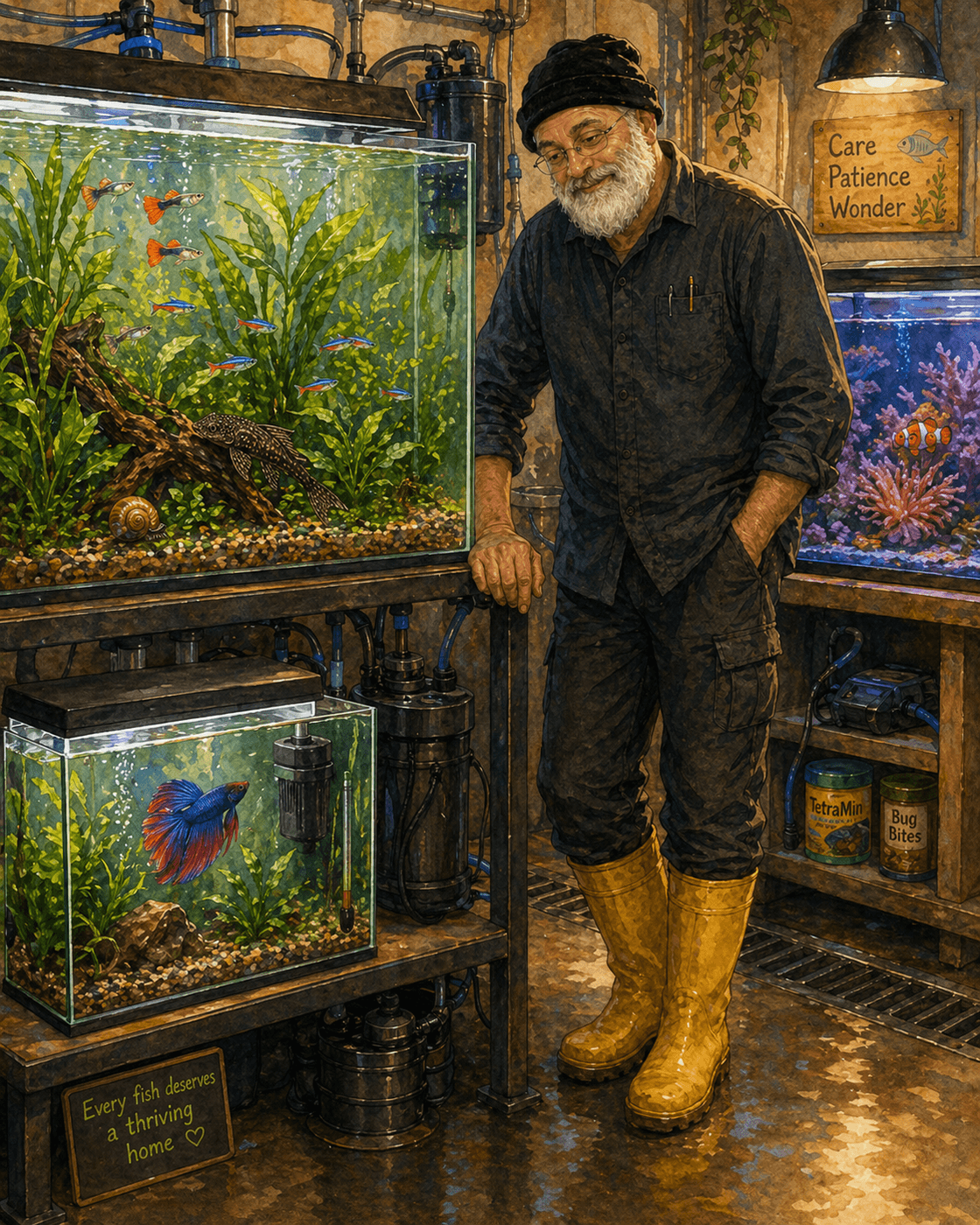
A warm illustrated story world for curious readers ages 7–10, created by Yechiel, who has kept fish for 49 years. Real biology. Genuinely funny.
Help a grumpy little guppy feel happy again! Drip his new water in nice and slow, watch how he feels, and earn the Bridge Fish badge. A free science game — no login, plays right in your browser.
▶ Play nowFrom the warm Greenhouse to the mysterious blue-lit Salt Wing, there are dozens of creatures to discover. Navigate all the zones on our official illustrated map!
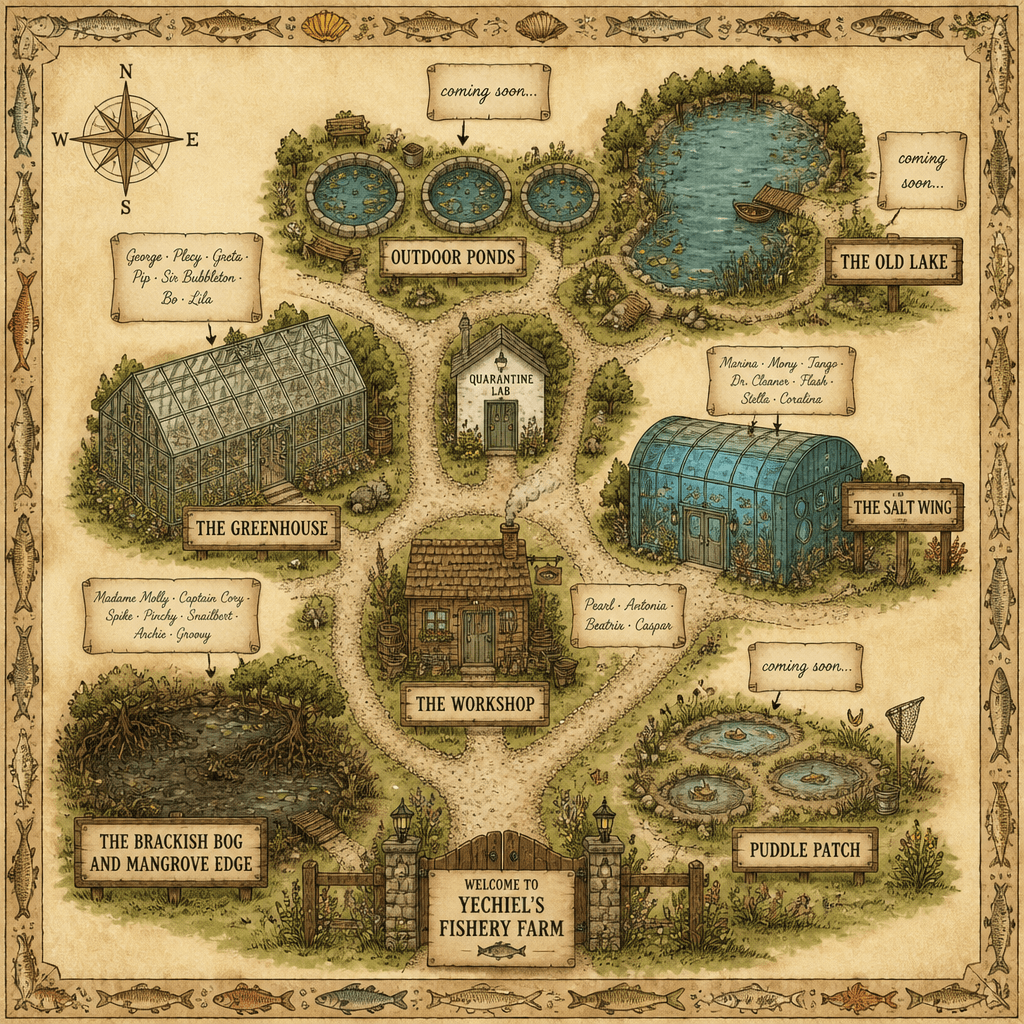
Tropical freshwater - warm & humid - tube lights hum zz-ZZ
Residents — tap one for the real biologyMarine aquaria - cool, blue-lit, mysterious
Residents — tap one for the real biologyHalf-salty, half-fresh - muddy roots - nursery for baby fish
Residents — tap one for the real biologyLogbooks - microscope - tea kettle - Quarantine Lab adjacent
Residents — tap one for the real biologyQuiet - ancient - freshwater - the farm's oldest neighbour
Residents — tap one for the real biologyLively freshwater, sun-dappled / Seasonal, rain-fed
Residents — tap one for the real biologyHover or tap a pin to meet each zone's residents.
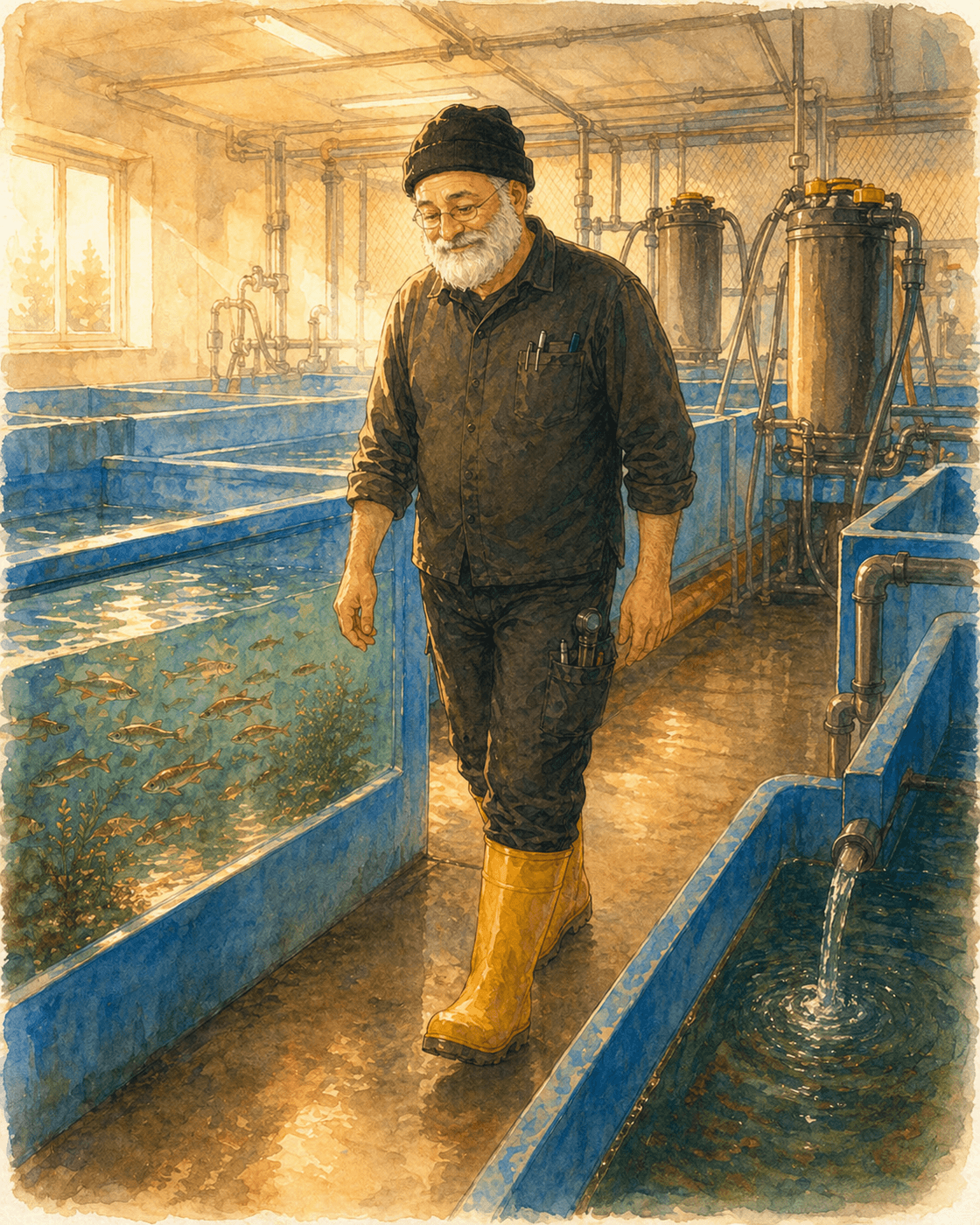
Yechiel reads the very first chapter of Book 1 aloud. Perfect for early readers, car journeys, or just finding out if George is as grumpy as advertised.
George the guppy wakes up one morning to discover his water feels all wrong — and, being George, he has strong opinions about it. As he grumbles his way around the tank, he learns his first lesson in what really keeps aquarium water healthy. It's the gentle, funny opening to George the Cranky Guppy: The Water Has Opinions (Book 1).
You can read the full text for yourself: grab the free sample chapters or browse the books.
Kids love clubs, and we love fish! Join completely free of charge. The only cost? Telling us about your aquarium!
Read the full Aquarium Club guide
* Note for our young readers: Please ask your parents' permission before signing up!
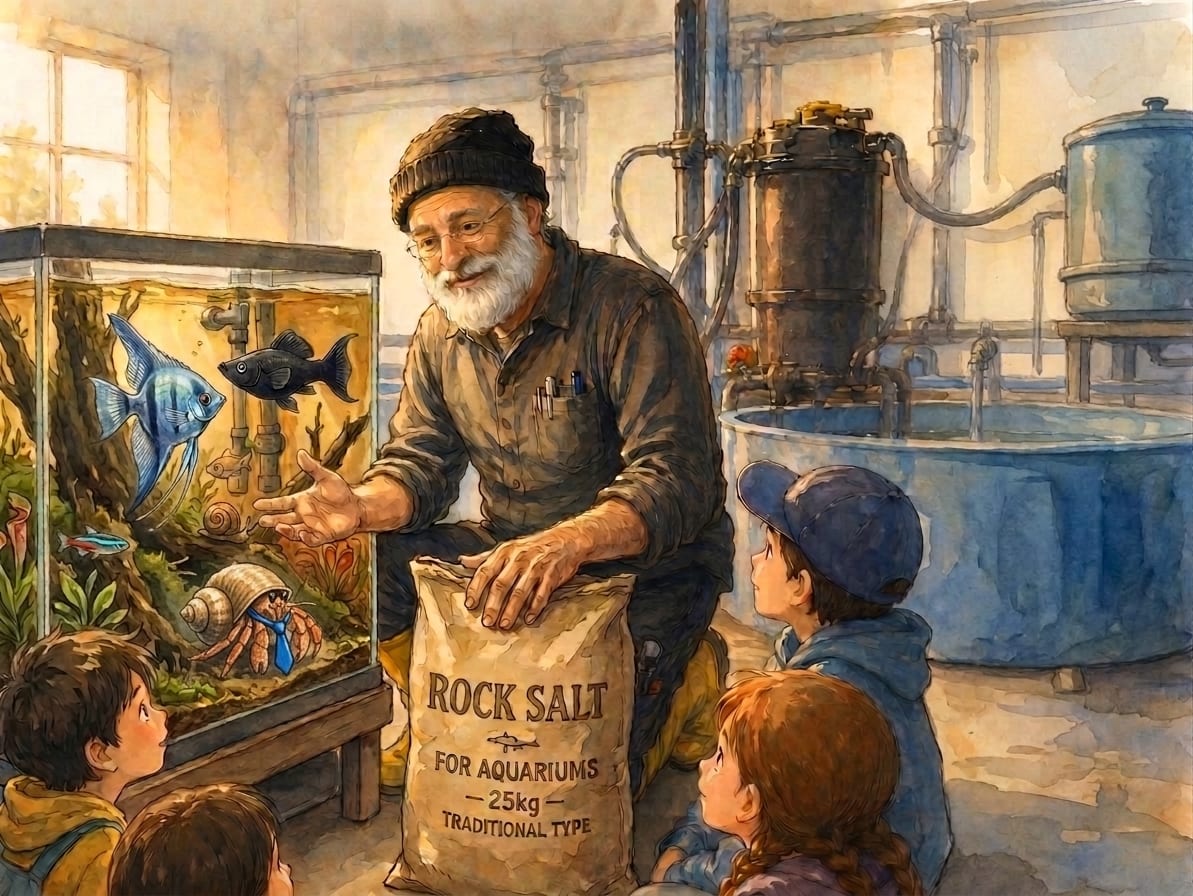
Gift a friend 10% off their first order. When they buy, we'll thank you with 10% off your next one.
Hi, I'm Yechiel Kuperman. I'm a marine biologist, and I've been keeping and working with fish for nearly 50 years.
I created George the Cranky Guppy as a gentle, scientifically grounded, and dyslexia-friendly series of STEM books for children and curious young readers ages 7–12.
Inside Yechiel's Fishery Farm, guppies grumble, crabs panic, biofilters have opinions, and children discover that science can be funny, emotional, and full of life.
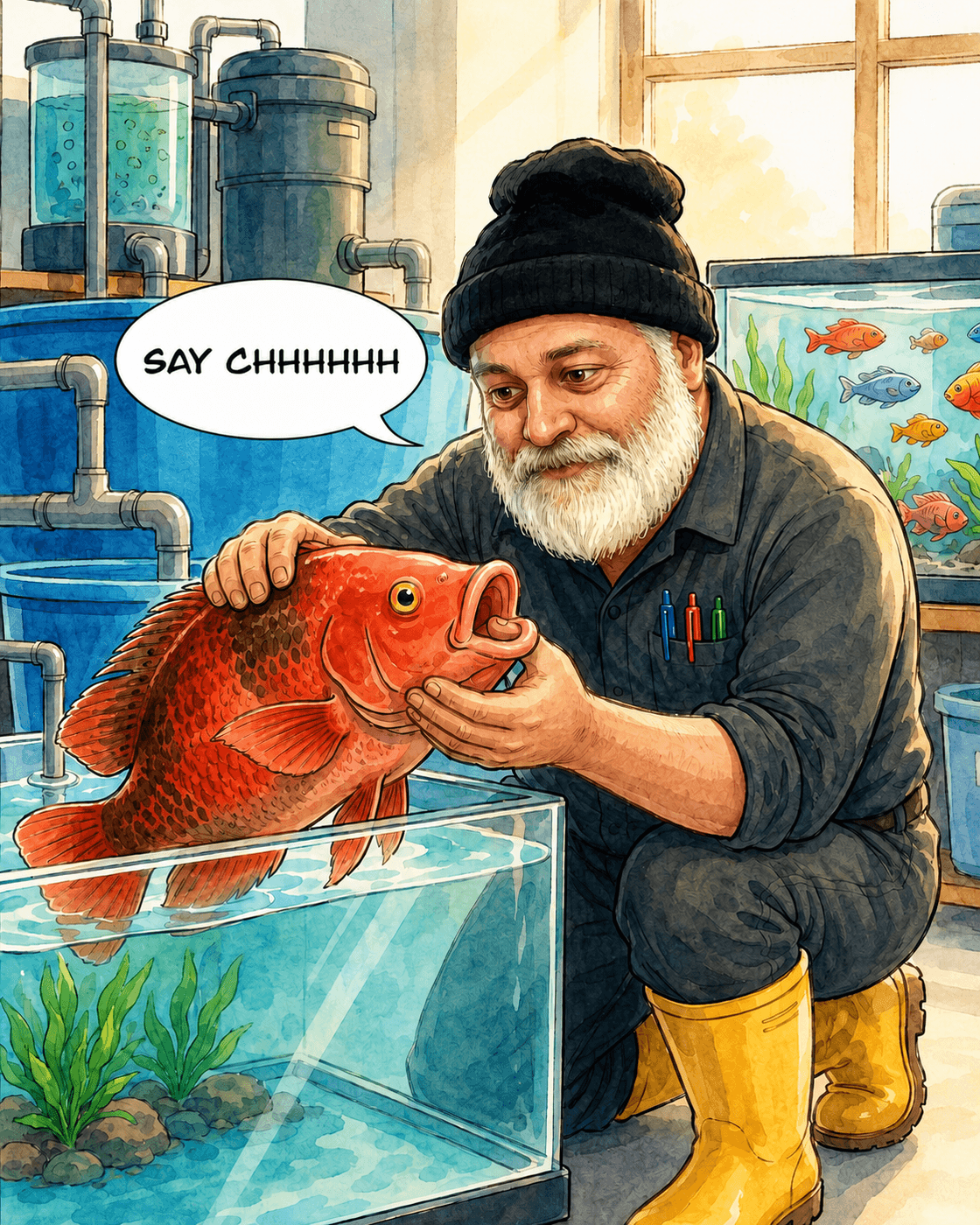
Get two free sample chapters from Books 1 and 5. Read, share, decide.
Do you keep fish at home? Learn Yechiel's golden rules and download our quick advice sheets to keep your aquarium residents healthy, happy, and swimming strong.
Guppies, crabs, and biofilters have a lot of opinions. Step inside the tanks and hear directly from the residents of Yechiel's Fishery Farm.
"I am a black molly. A lyretail black molly, to be precise — my tail is shaped like a lyre. It does not make me a liar..."
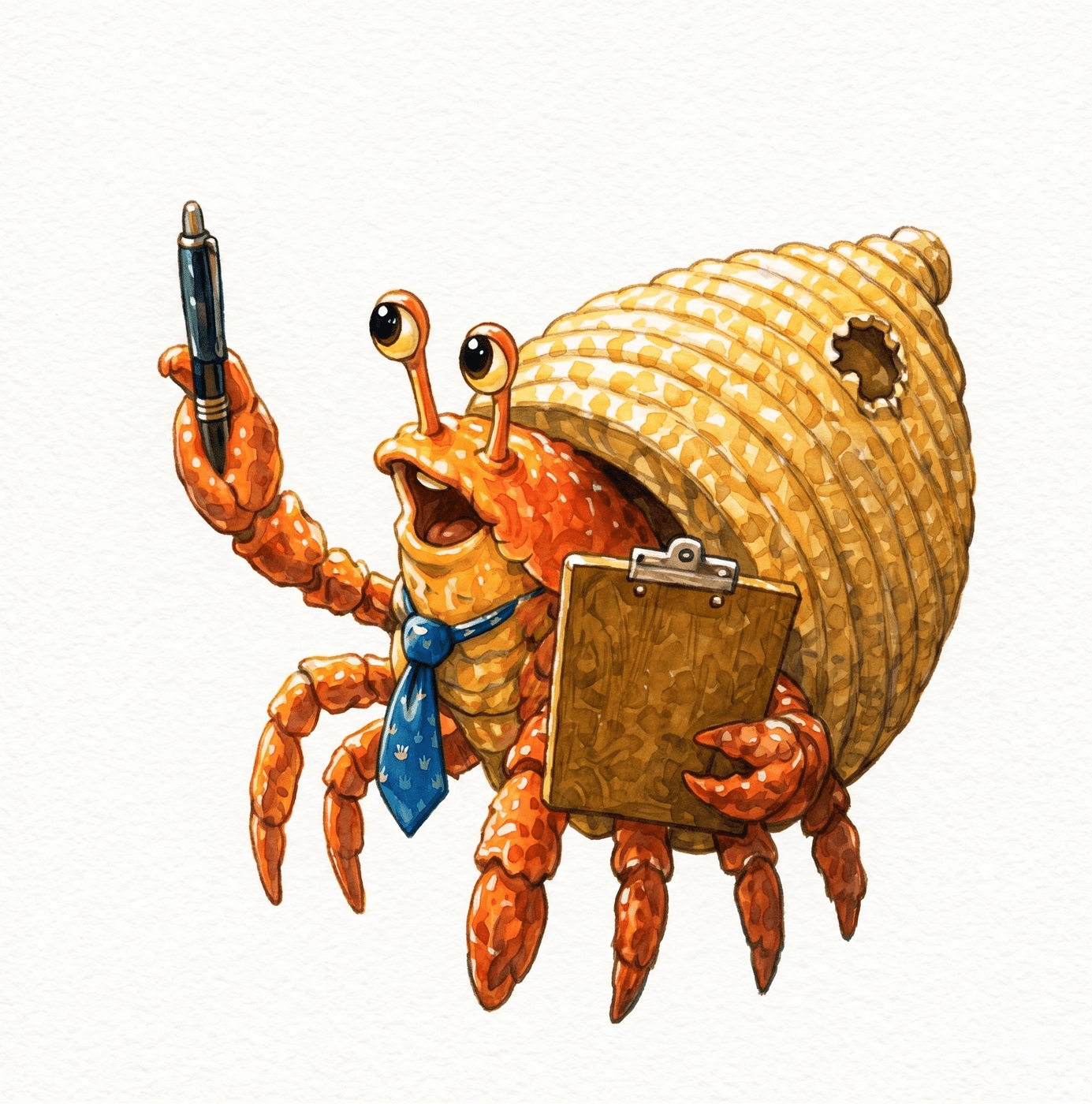
"George the guppy says he is on an internet. I have looked all around the tank. There is no net. I have walked the whole bottom..."
Real answers about the books, the science behind them, and the series.
George the Cranky Guppy is written for children ages 7–10 (grades 2–5). Each book features short chapters, wide spacing, clear dialogue, and character-driven humour that keeps reluctant readers turning pages — while delivering genuine marine biology content aligned with NGSS science standards.
Yes — entirely. Every biological fact, ecosystem interaction, and fish behaviour in the series is verified by the author, Yechiel Kuperman, who has kept fish for 49 years. The osmosis in Book 1 is real. The mosquito larva food chain in Book 2 is real. The halocline formation in Book 3 is real. We do not simplify the science — we make it funny.
These books were designed from the ground up with dyslexic and reluctant readers in mind. Short paragraphs, generous line spacing, conversational dialogue, humour-led storytelling, and an emotionally engaging protagonist all work together to reduce reading friction without reducing the quality of the content. Many parents report that their reluctant readers finish a George book in a single sitting.
Across the 10-book series, children encounter: water chemistry and pH balance, osmosis and osmoregulation, the nitrogen cycle and biological filtration, food webs and trophic levels, mosquito biology and biological pest control, halocline formation and water density, aquatic respiration and gill function, fish physiology and stress response, ecosystem management and biodiversity, and marine vs. freshwater biology. All topics are embedded naturally inside the stories — never as lessons.
Yes — our STEM Educator Hub contains free NGSS-mapped lesson plans for Books 1–3, comprehension and vocabulary quizzes, classroom posters, printable reading reward badges, and vocabulary sheets. All materials are available with no login, no paywall, and no student tracking. Visit the Educators page to download everything.
The complete Yechiel's Fishery Farm series is planned for 10 books across two story arcs. Books 1–5 (The Water Has Opinions, George and the Mosquito Patrol, George Meets the Salt Line, The Fizzy Bog Mystery, and the George series finale, George Finds His Water) are currently available. Books 1 and 2 are on Amazon and direct from the farm; Books 3, 4 and 5 are farm-exclusive, sold only direct. Books 6–10 are in active production. You can sign up on our Books page to be notified the moment each new title releases.
Most science books for children explain the concept first and add a story on top. We do the opposite: we tell a funny, emotionally real fish story, and the science emerges naturally from what the characters experience. George does not attend a lecture on osmosis — he wakes up in the wrong tank and his body starts doing things he does not understand. Children absorb the biology because they are too busy worrying about George to notice they are learning.
Absolutely. The series is designed for elementary classrooms as a companion to life science and ecosystems units. Each book comes with a full chapter-by-chapter teacher guide, discussion questions, key vocabulary, and a hands-on classroom activity. The books map to NGSS standards for grades 2–5 and support cross-curricular integration of science and English language arts.
Every chapter runs 1,000–1,400 words — about one bedtime sitting. Seven-year-olds usually enjoy the books read aloud; most 8–10-year-olds read them independently. Chapters end on a hook rather than a cliff drop, so a reluctant reader gets the satisfaction of finishing a whole chapter and the pull to start the next one.
The books are set in Atkinson Hyperlegible, a typeface designed by the Braille Institute with distinct letterforms so b, d, p, and q cannot be mirror-confused. Body text is 14pt with 1.5× line spacing on soft cream paper, paragraphs stay 1–3 lines, and every line of dialogue starts on its own line.
The same low-friction design helps: short chapters, 1–3-line paragraphs, generous white space, and dialogue broken onto separate lines all reduce the visual load that makes attention wander. The humour does the rest — a child who is waiting for George's next complaint has a reason to stay on the page.
After 49 years of keeping fish, Yechiel's answer is a small group of hardy livebearers — guppies, platies, or mollies — in a properly cycled tank of at least 40 litres. They are forgiving of beginner mistakes, active enough to be interesting, and safe to handle as a family project. If you don't take to livebearers or can't get them, gouramis and paradise fish are a superb second choice: they are labyrinth fish that gulp air straight from the surface, which makes them even hardier and more forgiving than most for a first tank. Our free Aquarium Care Guides walk you through the setup step by step.
More questions? Contact us →
Swim four watery worlds, pop bubbles and help George find his way home — right in your browser.
Free · No download · No sign-up · Works on phones, tablets and computers